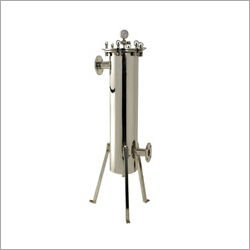
Bag Filter Systems provided are used for the treatment of groundwater, cooling water, industrial process water, wastewater, and many other purposes. These systems are used to remove suspended solids from liquids in various scenarios and industries. In every industry that needs bag filter, these bag filters are placed inside of bag filter housings for the purpose of purification by removing solids from wastewater. Bag Filter Systems are typically used in the treatment of industrial process water, wastewater, groundwater, and cooling water, along with many others. These systems are very effective as well as economical to use and install too.
Specification
|
Country of Origin
|
Made in India
|
|
Material
|
SS 304, SS 316
|
Versatile Filtration for Industrial Needs: Bag Filter Systems accommodate a broad range of bag lengths and diameters, enabling tailored solutions for varied industries. Their modular, cylindrical or vertical construction ensures compatibility with diverse installation spaces, while customizable inlet/outlet sizes and filtration ratings provide flexibility for different process requirements.
Efficient Dust Collection & Maintenance: Equipped with differential pressure gauges, inspection doors, and options for explosion vents, these systems simplify operational monitoring and maintenance. The choice of polyester or polypropylene filter bags, alongside optional corrosion-resistant coatings, delivers outstanding filtration efficiency and durability in demanding environments.
FAQs of Bag Filter Systems:
Q: How do I select the appropriate bag filter model for my specific industrial application?
A: When choosing a bag filter system, consider your required flow rate (100 m/hr to 40,000 m/hr), desired micron rating, operating temperature (up to 180C or 250C for special designs), and dust load. The number, length, and type of bags (polyester or polypropylene), as well as construction materials and mounting style, can be customized to match process conditions and compliance requirements.
Q: What maintenance procedures are recommended for bag filter systems?
A: Routine maintenance includes visual inspection of bags via inspection doors, monitoring differential pressure gauges, and cleaning the system through its designated method (pulse jet, shaking, or reverse air). Periodically check gaskets for leaks and replace filter bags as needed to uphold filtration efficiency above 99%. Automatic rotary airlocks simplify dust discharge, reducing manual intervention.
Q: When is internal or external corrosion-resistant coating necessary?
A: Corrosion-resistant coatings are advisable if the filtered air contains corrosive dust or chemicals, or if the installation environment is humid or chemically aggressive. Both internal and external protective coatings ensure system longevity, safeguard structural integrity, and optimize operational reliability in challenging industrial conditions.
Q: Where can these bag filter systems be installed, and is on-site setup provided?
A: Bag filter systems can be floor-mounted or skid-mounted for flexible placement in manufacturing plants, warehouses, or production floors. On-site installation services are offered, ensuring precise setup and integration with existing process equipment for optimal performance and safety.
Q: What cleaning methods are available and how do they benefit system usage?
A: Cleaning options include reverse air, mechanical shaking, and pulse jet, selectable based on application and available power (typically 35 kW for pulse jet systems). Proper cleaning maintains low pressure drop, maximizes filter lifespan, and supports uninterrupted, efficient operation, particularly in continuous production environments.
Q: How does the modular design enhance bag filter system usability?
A: Modular construction enables easy scaling, upgrades, and maintenance. This design facilitates quick replacement of bags, integration with accessories like explosion vents, and adaptation to changing process needs, ensuring cost-effective and future-proof dust filtration solutions.




 Send Inquiry






 Send Inquiry
